

NEWS / 11.9.2026
Maria Nurmela is a dancer, choreographer, pedagogue, and certified Feldenkrais practitioner. She has worked in Finland and internationally since 2002. Many well-known choreographers have employed Maria in their works, but since 2016 she has focused on creating and producing her own multidisciplinary productions. In her work she is interested in themes of embodiment and gender, ecological questions, intergenerationality, and process-based methods at the intersections of different art forms.
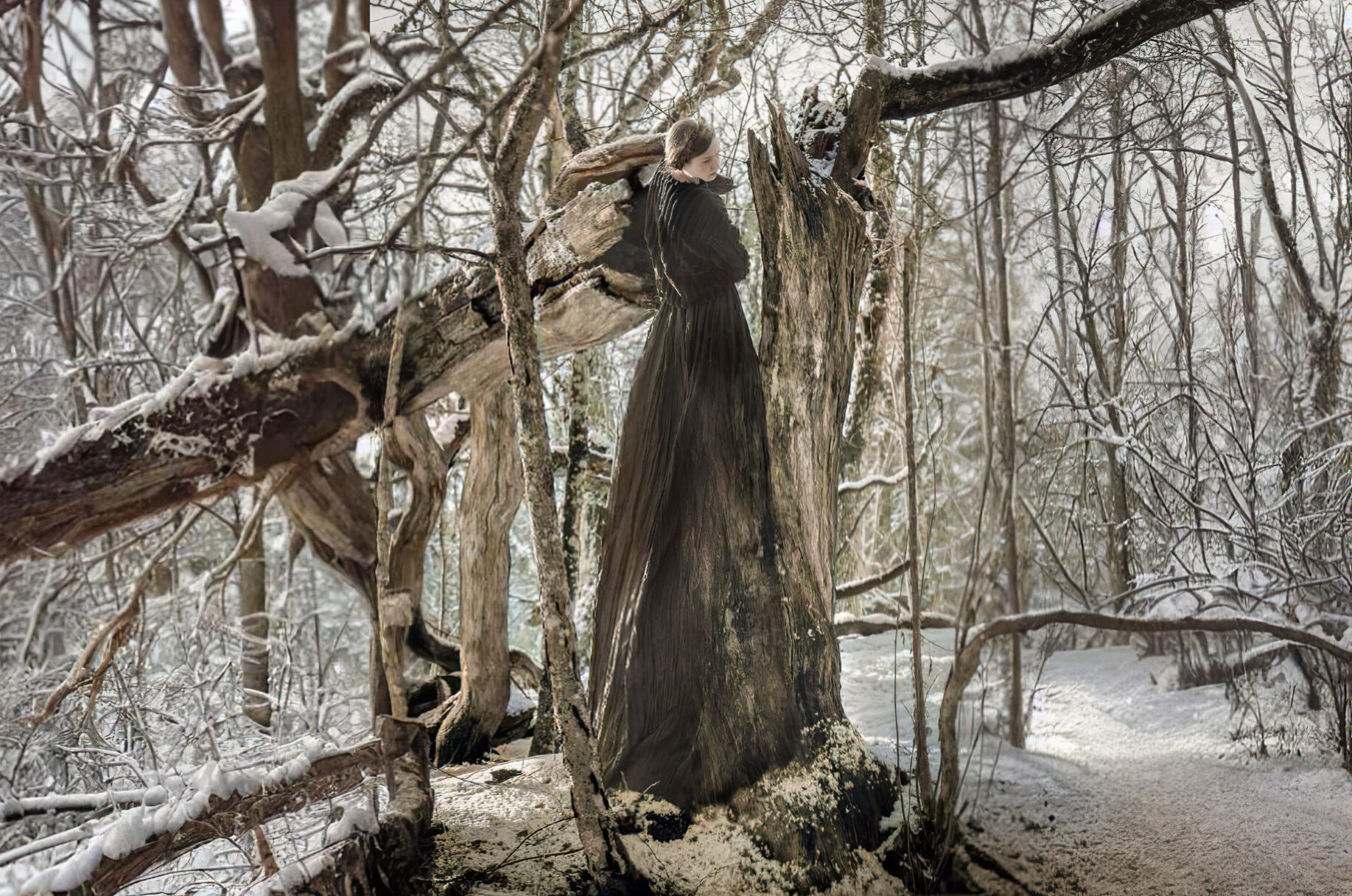
Entanglement is a multidisciplinary art project and field study that has been ongoing since 2022. It explores the relationship between humans and the more-than-human world at a time when the climate crisis and the loss of biodiversity are reshaping the way we experience time, physicality, and our connection to other living beings. Launched by Nurmela, photographer and filmmaker Vesa Loikas and composer and soprano Jane Sheldon, the project originated from encounters in the ancient oak grove of Vaarniemi — a Natura 2000 protected area located in Rauvolanlahti, Kaarina, which contains the remains of a Bronze Age burial site and has long been considered a sacred place. Sound designer Jaakko Vastapuu, lighting and set designer Erno Seppälä, dance artists Gesa Piper, Riina Kalmi and Jonna Eiskonen, as well as mentor Bart H.M.Vandeput have joined the project in various phases.
The immersive installation performance Entanglement: I am a mouth, I am a tree will premiere at Kiasma Theatre in Helsinki in October 2026.
Interview with Maria Nurmela
The Entanglement project is described as a time capsule that reflects the intertwining of the destinies of human and nature. How do you hope your works affect viewers right now, amid climate change and the loss of biodiversity —and/or how might they speak to future generations?
Working in an area significant from both a natural and cultural-historical perspective, regardless of the weather or season, and the encounters we’ve had there with beings of other kinds have given rise to fictional narratives, which we transform into various artistic actions — asking how humans might recognize the visible and invisible bonds that connect us to all living things, and how dialogue is possible when there is no common language.
So far, this project has resulted in a short film that premiered at the Manifesti Festival in Turku 2023, as well as an AR-based, participatory art portfolio titled Metsänhaltijat (Skogsvaktarna) that is experienced in a museum setting as a somatic and sensory installation. The immersive stage work Entanglement: I am a mouth, I am a tree will premiere at the Kiasma Theatre in October 2026, after which the research will continue, and the next presentation will take place in August-September 2027 at the WAM X multidisciplinary gallery of the Turku Art Museum.
It was clear from the outset that we would not bring actual artworks to Vaarniemi, so as not to destroy its delicate ecosystem through our work; instead, our work offers a kind of interpretation: an invitation to experience and reflect on one’s own relationship with nature through artistic abstraction
Over the past four years, our practice has been based on various observational exercises that have engaged movement, sight, hearing, smell, and touch. The Feldenkrais Method has been at the heart of our interdisciplinary process: through it, we have been able to immerse ourselves in listening to our own bodies and the surrounding landscape in a holistic way, as well as to perceive our bodies as part of a broader ecological network, not separate from it. The groundedness, connection to gravity, slowness, and precision of body awareness fostered by Feldenkrais work have also provided an important starting point for our interdisciplinary practice. As artists coming from different artistic fields—and with very different personalities—this shared practice, which in a way also calms the nervous system, has been vital and has paved the way for moving ethically from one artistic field to another, blending and combining different artistic languages, and striving to find a common language of presentation and being between them.
I feel that the four-year Entanglement project abd the field research conducted in the Vaarniemi oak grove nature reserve have broadened my artistic thinking, but also challenged it in many ways. The project deals with encounters with more-than-human otherness, and at the same time, the creative process itself has been an exercise in encountering otherness between people; every artist has a different logic of creation as well as a dofferent relationship to time, process, and what “making” means. Negotiation, listening, and moving towards the unknown–as well as relinquishing one’s own language and logic in order to hear the emerging work creature–have been important, challenging, and rewarding aspects of the process. In this sense, entanglement is not only the subject of the work but also the way it was created—that is, how, over the course of four years, we have become intertwined with one another’s processes, or how the human body and other species share temporal matter. Entanglement has been an attempt to find a deeply embodied, multidisciplinary, and non-conceptual way to deconstruct anthropocentrism and the challenges we face in the world we live in. Paradoxically, even though in our work we have done our best to challenge precisely this human-centered worldview and to genuinely engage with other beings the Entanglement project has turned our gaze inward, toward how our lives are directly connected to and intertwined with the living and more-than-human beings that surround us. The ethical considerations have been quite significant, at times even overwhelming, and we have tried many times to answer the question of why we make art.
Now that the next step in Entanglement’s four-year field research—a production to be staged at the Kiasma Theatre—is upon us, we as a working group find ourselves in a situation where we are considering how the performance “works” without illustrations. We certainly cannot bring the forest into the theater; we can only use the language of art to convey our current experiences with other beings. It has been an incredibly fascinating challenge to move away from representation and to answer the question of whether this performance even needs human beings. It is exciting that, at the same time, this kind of translation into the language of theater has now brought in themes of caring, care, safety, and a sense of belonging among us humans. At the same time, we also know that we cannot fully convey or share everything we have experienced in Vaarniemi with the audience who joins us in the same space, the Kiasma Theatre.
What we hope the audience will experience at Kiasma in October is an invitation into our experience, but also the freedom to imagine their own forest landscape, the oak trees of their childhood, and to reflect on their own personal meanings. And also a space to quiet down and close their eyes.
Since the exhibition at Kiasma is not the only outcome of this artistic research process, we also hope that the public will experience the project’s other works. Kiasma is just one stage in a long process. It is not a final, fixed result, but rather part of an ever-evolving and deepening process of exploring the connection between humans and the more-than-human.
Throughout your career, you have worked with artists from many different countries. How has encountering these cultural and artistic differences enriched your own artistic practice?
I completed my dance degree in Germany at the Folkwang University, which was a thoroughly international arts university. My class alone included students of twelve different nationalities, representing nearly every continent. Thanks to my time at Folkwang, collaboration across cultural boundaries has come very naturally to me, and it’s something I’ve always wanted to pursue. I find it truly fascinating to healthily question and redefine my own worldview, my understanding of humanity, and my conception of art—a process that inevitably arises in international working groups. When one “has to” explain artistic and even very mundane matters or view them through a different lens—through the lens of otherness, in a language other than one’s own—one’s artistic thinking remains sharp, and in this way, the creative processes can reach quite deep levels.
We have a long history with Jane Sheldon, an Australian who is part of the Entanglement project. We performed together for nearly 10 years in Borrowed Light by Tero Saarinen and toured around the world. Each performance began with us sitting side by side on stage, sharing our feelings and, to a large extent, everyday matters as well. The ten years of Borrowed Light were, in and of themselves, a special experience that is difficult to explain to those outside the group, but because we shared it specifically with Jane, it also fostered a special trust and genuine interest in each other’s artistic work, as well as, little by little, the collaboration we’ve been engaged in since 2014. It is worth noting that most of our collaborative works have been created remotely using various platforms, with Jane in Australia and me in Finland.
Collaboration with English choreographer Theo Clinkard in The Days Project has also been special. The project, which began as a collaboration between Ville Oinonen and me—and which Theo jumped into almost blindly—has grown into an eight-year journey and a series of shared life experiences, and we are currently planning future performances and workshops.
Since its premiere in December 2018, The Days has toured extensively throughout Finland, as well as internationally in the UK, Switzerland, Siberia, Scotland, Bulgaria, Estonia, Luxembourg, and the Åland Islands. It was also the only Finnish contemporary dance production featured in the 2022 Nordic Bridges cultural year, a collaboration between Canada and the Nordic countries that toured British Columbia and Indigenous territories The Days Project consists of a duet created by Theo for me and Ville, based entirely on a specific improvisation task, as well as a workshop led for local seniors. Through our work, we’ve had the opportunity to meet hundreds of seniors, share our lives through dance, and also learn an incredible amount about different cultures. It has been valuable to introduce the local community to our understanding of dance, but perhaps even more valuable has been learning new things from their perspectives on the art of dance.
Theo, Ville, and I have bonded as a team built on deep trust and dialogue. This is evident in the work itself as well as in the numerous workshops we conduct. Ultimately, it is also about the many different facets of humanity—facets that the art of dance hopes to touch in some way.
The Days Project will next be performed at Plesni Teater Ljubljana. Community workshop will be held 6.12.2026 and performance 7.12.2026.
You have worked as a dancer for more than two decades. What do you think about middle age?
I see many parallels between the ecological themes at hand and middle age. Both involve something irreversible, an unquestionably biological process that is uncontrollable and inevitable. And above all, they involve time: the time of the human body, the time of nature, and human hopes regarding the passage of time. Middle age forces me to realize that my body lives by its own time. Hormonal and cellular changes occur regardless of my will or plans. The same applies to ecosystems: an oak tree does not adapt to a human schedule, and biodiversity loss does not wait for political consensus. Both teach us that we do not control time as we thought we did; that we are part of the cycle whether we like it or not; and that if we treat ourselves and the environment poorly, our demise will come faster.
The aging body—especially that of women and in the art of dance—remains, unfortunately, all too often invisible or silenced in our culture. I believe this is comparable to the relationship between humans and nature in our time.
In middle age, one is forced to ask anew who one is, as previous roles change. In the ecological crisis, people are similarly forced to reexamine their place—not at the top of the hierarchy, but as part of a network with other living beings.
The body knows before the mind has time to process it. Nature follows its own course. When either of them changes—or is lost—we find ourselves, in a way, mourning something that cannot be restored or repaired. We simply have to face that change.
Read more about the work of Maria Nurmela: https://www.marianurmela.com
Entanglement: I am a mouth, I am a tree at Kiasma Theatre 24.-25.10.2026: https://kiasma.fi/en/performances/entanglement-i-am-a-tree-i-am-a-mouth/
Maria Nurmela’s solo work As you like it in Sofia, Bulgaria 28.11.2026: https://derida.eu/en/
The Days Project in Ljubljana, Slovenia 6.-7.12.2026: https://ptl.si/
Photos:
Entanglement: Vesa Loikas
Maria Nurmela’s photo: Timo Ollila